
WPMathPub: Reliable LaTeX Math Rendering in Social Networks
TL;DR
Most LaTeX plugins only work inside the browser, so your equations disappear in RSS, email, social previews, and WordPress comments. WPMathPub renders math as portable PNG images, so your LaTeX survives everywhere your readers actually read — enabling real mathematical conversations across the open web.
Most WordPress math plugins work beautifully on your website — right up until your content leaves the browser. The moment your LaTeX travels into RSS feeds, email digests, social previews, or comment notifications, the equations often disappear. What looked perfect on your site becomes blank space everywhere else.
This isn’t a small edge case. It affects teachers, researchers, and anyone who publishes technical content online. Your readers don’t always visit your site directly.
Instead, they may read through Feedly, Inoreader, Apple Mail, LinkedIn previews, or WordPress comment emails. If your math vanishes in those channels, your message vanishes with it.
That’s the problem this article explores — and the reason WPMathPub exists over and above LaTeX math publishing.
When Math Becomes Portable
Portable math changes the topology of online communication, creating new channels where equations can appear, persist, and invite participation.
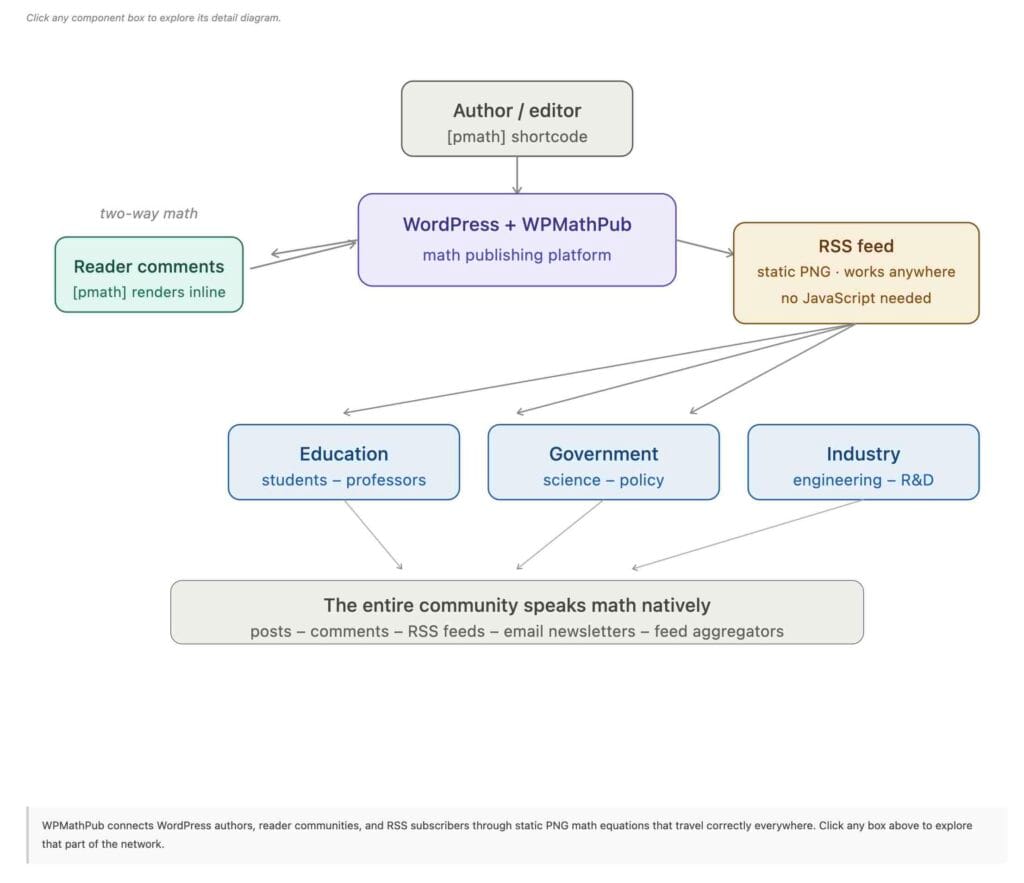
The interactive HTML chart above captures this shift visually. Each node represents a place where the equation can appear; each connection represents a new opportunity for someone to learn, respond, refine, or extend the idea. Once math is rendered as a PNG, every platform can display it — and every reader can participate.
A Classroom Example
Professor Alvarez liked to keep his weekly physics challenges simple. Every Monday he posted a short derivation exercise on his class blog — usually a clean LaTeX equation rendered with the familiar MathJax plugin. His students followed the blog through RSS readers like Feedly, so the homework appeared automatically in their daily feed.
At least, that was the plan.
This week’s assignment was the opening step of simple harmonic motion (SHM):
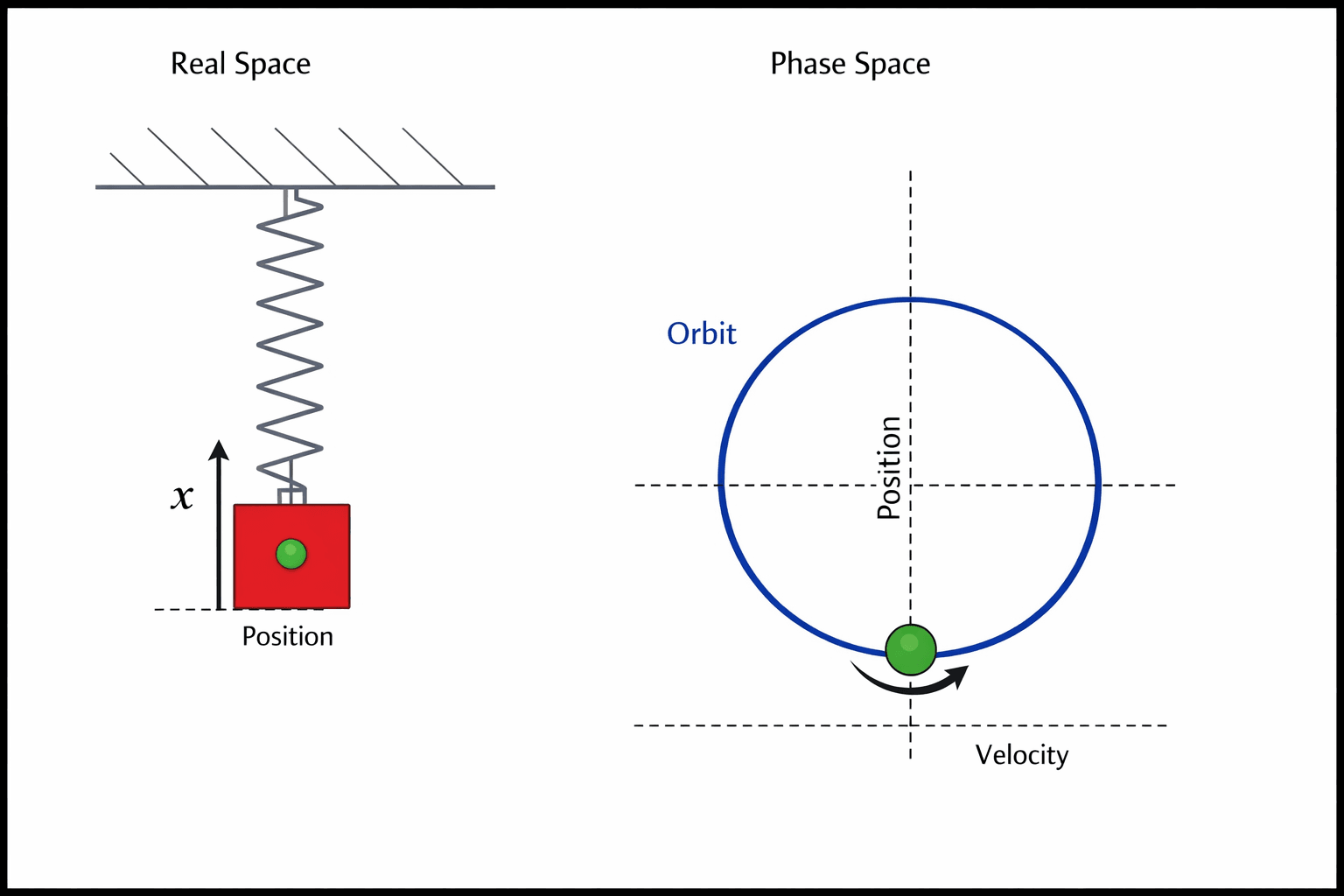
Equation 1: SHM isn’t just an equation — it describes a physical system that oscillates back and forth with a restoring force proportional to displacement. Figure 1 shows the same motion represented by the equation above, giving students a visual anchor before they explore the different solution forms.
Then he added a short prompt beneath it:
“How many different forms of the SHM solution can you write that still satisfy this equation?”
Hint: Name a function that is the negative of itself after double differentiation.
He published the post, closed his laptop, and went to lunch.
By early afternoon, two emails had arrived:
“Professor, the equation is missing in my feed.”
“I only see blank space.”
Puzzled, he opened his own RSS reader. Sure enough — the equation had vanished. MathJax simply didn’t survive the trip through RSS. The feed showed plain text, no math, no hint of the original expression.
He checked the WordPress post again. Everything looked perfect on the website itself. But outside the browser? Nothing. No math in RSS. No math in email digests. No math in social previews. The equation existed only on the blog — nowhere his students actually read it.
That’s when he went searching for a better solution.
He found WPMathPub, a plugin that didn’t rely on the reader’s device to render equations. Instead, it generated clean PNG images server‑side — images that could travel anywhere a normal image could go.
He installed it, updated the post, and refreshed his feed reader.

There it was. The same SHM equation, perfectly crisp, sitting right inside the RSS feed. No JavaScript. No special rendering engine. No missing homework.
Even better, the comments section now supported math too. Students — even those not logged in — could reply with real equations using the same LaTeX syntax. The plugin handled the rendering automatically.
The Comment Thread (Open‑Source Metaphor)
By evening, the comment thread looked less like a homework submission box and more like a tiny open‑source project — two contributors refining each other’s work in real time.
Student 1 (first attempt):
“I can think of three equations that remain essentially ‘themselves’ after two derivatives (with a sign change):”
Cosine: 
Sine: 
Complex Exponent: 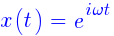
A solid start — but the third form was missing the amplitude, phase, and the real‑part extraction needed for physical motion. It was the kind of small oversight that happens all the time in collaborative work.
A few hours later, another student replied — the way a contributor jumps into a GitHub issue when they spot a subtle bug.
Student 2 (correction):
“In Ron’s complex‑exponential version, the equation isn’t quite accurate for Hooke’s Law.
I suggest this version instead:”
 Re
Re
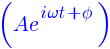
Why MathJax Fails in RSS (and Why WPMathPub Doesn’t)
MathJax is a brilliant in‑browser rendering engine — but that’s also its weakness. It depends on JavaScript running on the reader’s device to convert LaTeX into math. Inside a normal web page, that’s fine. Inside an RSS feed, an email digest, or a social preview, it’s a different story.
Those environments strip out or block:
- external JavaScript
- inline scripts
- <script> tags
- dynamic rendering engines
So when Professor Alvarez’s post left the safety of his WordPress page, the MathJax equation didn’t “break” — it simply never ran. The RSS reader saw the LaTeX as plain text and ignored it. No rendering engine, no math.
WPMathPub takes the opposite approach. Instead of relying on the reader’s device, it renders equations server‑side as PNG images. That means:
- the math is already rendered before it leaves WordPress
- the output is a normal image
- RSS readers, email clients, and social platforms all display it correctly
- comments can include math without requiring JavaScript
In other words:
MathJax sends instructions. WPMathPub sends the finished product.
That’s why the SHM equation suddenly appeared everywhere — not because the feed reader learned LaTeX, but because the equation arrived as a simple, portable image.
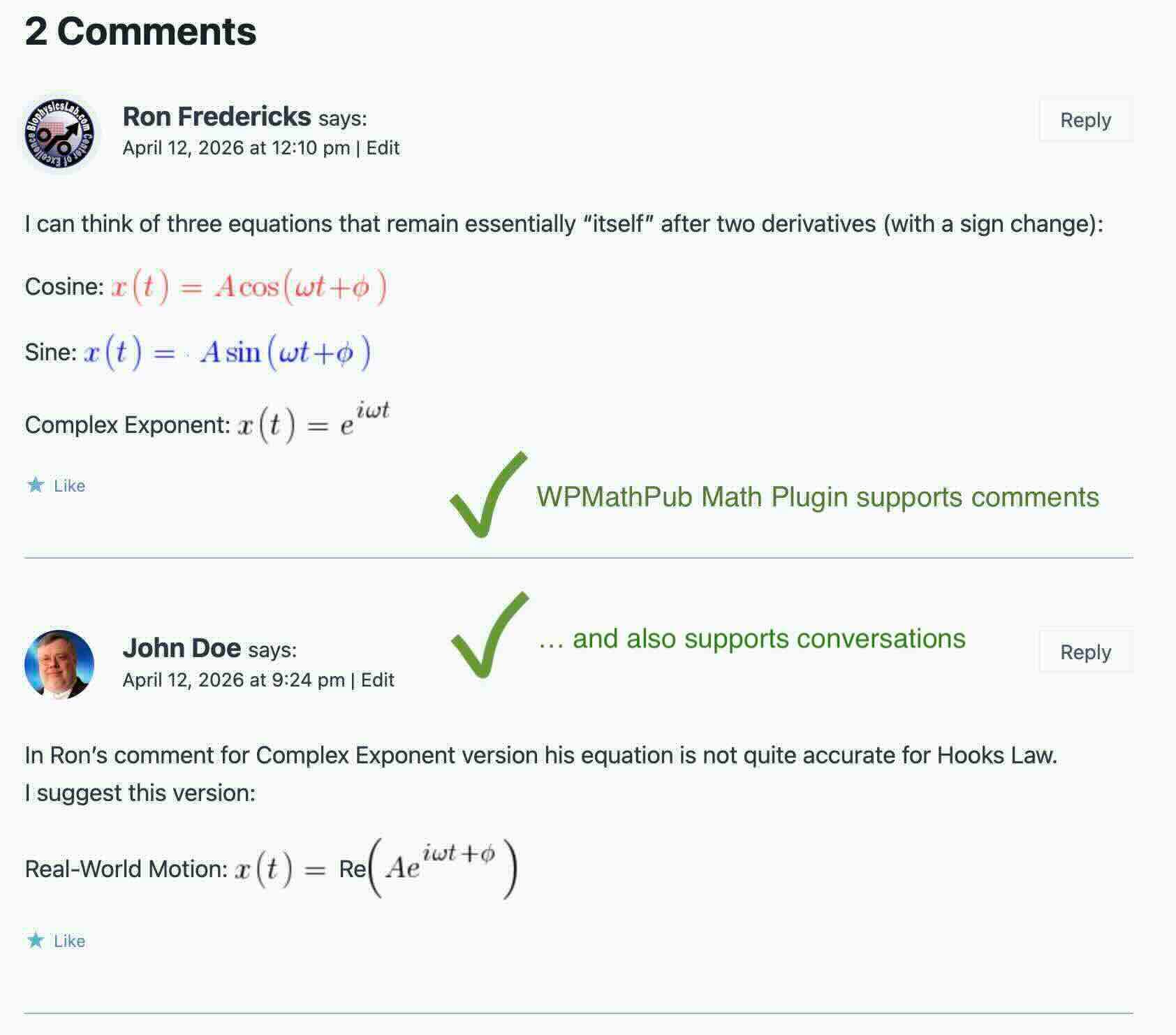
To make the difference concrete, here are the two equation formats side‑by‑side, followed by how they appear in a real RSS reader.
WPMathPub LaTeX Equation (PNG)
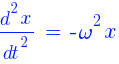
WPMathPub equations show in all RSS feeds. See Figure 2 below.
WordPress LaTeX Equation (MathJax)
WordPress LaTeX equations show in only some RSS feeds. See Figure 2 below.
Figure 2: WPMathPub (PNG) vs WordPress MathJax — only the PNG version is portable.
Some other modern RSS feeds tested do include the required MathJAX support to render LaTeX equations such as Thunderbird email client and NetNewsWire (Mac only). The main point here is that WPMathPub offers reliability across all RSS publishing platforms.
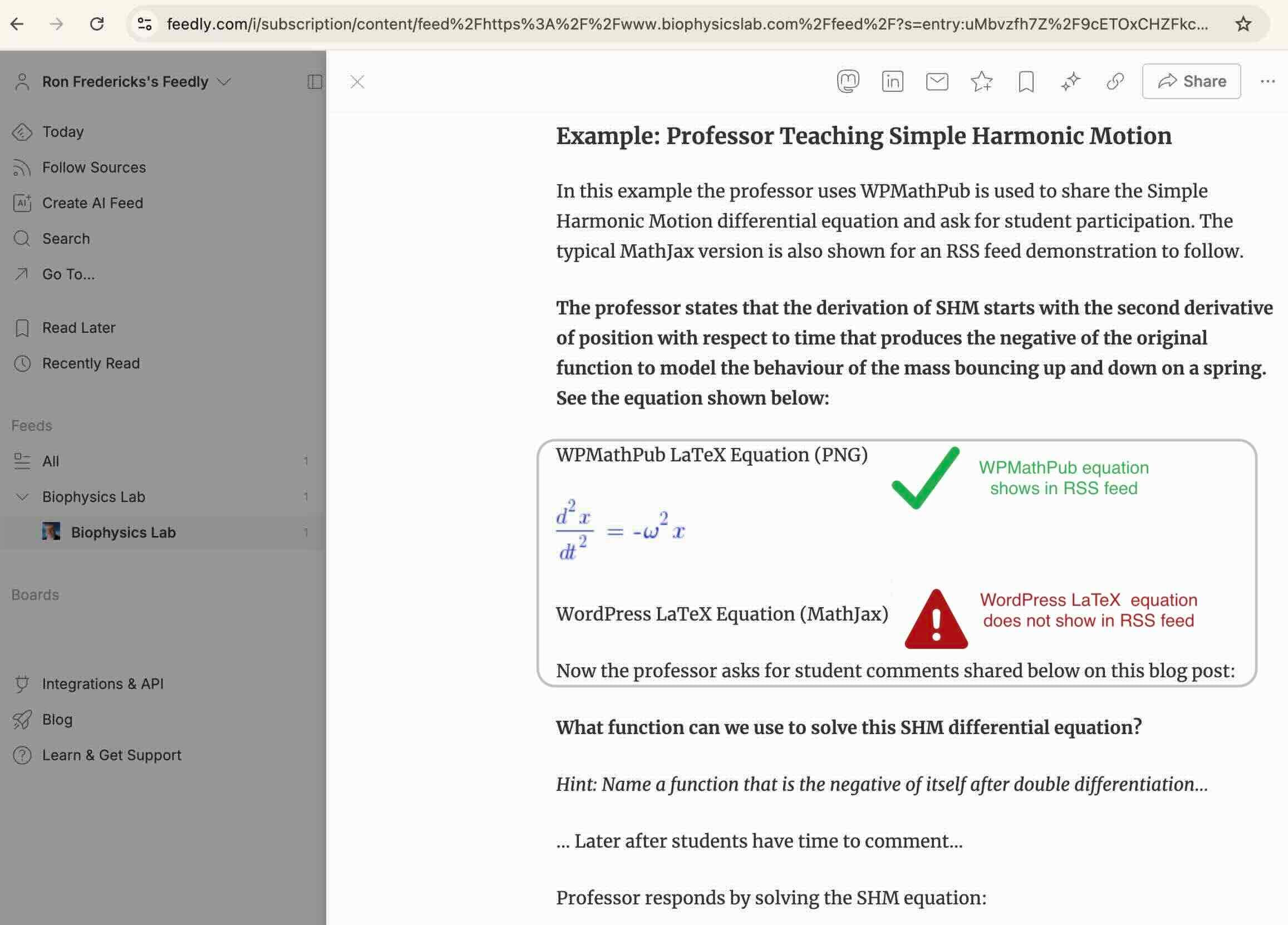
And finally, here’s what the comment thread looks like when students reply using WPMathPub — the equations render cleanly even in WordPress comments.
Because WPMathPub ships with Rosetta — a standalone PHP version of its live rendering engine — students can experiment with and validate their [pmath …] shortcode expressions outside WordPress before submitting comments: https://www.biophysicslab.com/wp-content/plugins/wpmathpub/demo/rosetta.php
Conclusion: Portable Math Creates New Social Possibilities
When mathematical expressions become portable — able to travel through RSS feeds, email digests, social previews, and even WordPress comments — the web behaves differently. Equations stop being trapped inside a single page and start circulating the way ideas naturally do: outward, across networks, into conversations, and back again.
A portable equation can appear in a student’s RSS reader, spark a correction in the comments, get reshared in a class group, or become part of a longer thread that evolves over days or weeks. This is the beginning of something new:
math discussions that behave like open‑source projects.
WPMathPub makes this possible by doing one simple thing:
rendering the math before it leaves WordPress.
Once the equation becomes an image, it becomes part of the open web’s natural flow.
This isn’t just compatibility.
It’s a new model for how mathematical knowledge moves through social networks.
Call to Action: Bring Portable Math to Your Own Community
Mathematical ideas shouldn’t be trapped inside a single webpage. When equations become portable — able to travel through RSS feeds, email digests, social previews, and comment threads — they start behaving like open‑source conversations: shared, corrected, extended, and remixed across networks.
WPMathPub makes this possible by rendering LaTeX as portable PNG images. Once rendered, your equations survive every platform they touch — and your readers can participate with math, not just text.
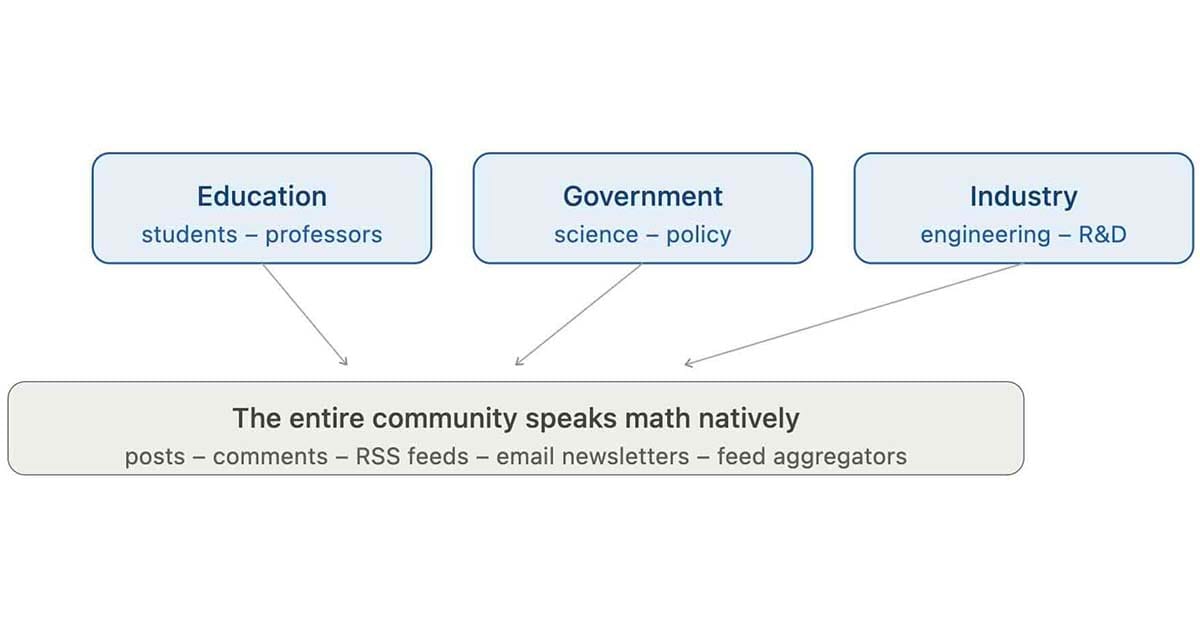
Below are three ways portable math can transform communication across education, government, and industry.
For Education
Portable math lets learning happen wherever students read — in RSS readers, LMS feeds, email digests, or comment threads. Equations remain intact, and students can reply with real math instead of screenshots or approximations. Use WPMathPub to turn your course blog into a living problem‑solving space where mathematical discussion grows naturally over time.
For Government
Public agencies often publish technical reports, policy analyses, environmental data, and scientific findings. Portable math ensures that equations remain readable across accessibility layers, archiving systems, email bulletins, and public RSS feeds. WPMathPub helps agencies communicate clearly and consistently, supporting transparency and public understanding without relying on client‑side JavaScript.
For Industry
Engineering teams, data scientists, and technical writers need equations that survive documentation pipelines, internal feeds, knowledge bases, and automated email summaries. Portable math ensures that formulas remain accurate and consistent across platforms — from internal blogs to customer‑facing documentation. WPMathPub provides deterministic, platform‑independent math rendering that fits seamlessly into modern technical workflows.
Need Implementation Help or Custom Development
Check out my concierge service if you want to go further than just download the current plugin:
Looking forward: WPMathPub’s rendering engine was designed from the beginning to run on any PHP platform. A standalone demo page is in development that will let any developer test and integrate math rendering without a WordPress dependency.”
References
- Download the plugin from the WordPress site wordpress.org/plugins/wpmathpub/
- Review the full syntax biophysicslab.com/wordpress-math-publisher-plugin/wpmathpub-syntax/
- Overview and examples https://www.biophysicslab.com/wordpress-math-publisher-plugin/
- Hafner, J. Physics of Oscillators and Waves. Coursera / Rice University (2026).
- Pedagogical note: Dr. Hafner introduces simple harmonic motion by asking students to identify multiple equivalent solution forms to the SHM differential equation — a technique that encourages representational fluency and deeper structural understanding implemented as math-enabled comments for this example.
- Using social network analysis to investigate mathematical connections in U.S. and Chinese textbook problems https://www.nature.com/articles/s41599-024-02991-w
How to Cite This Post
Fredericks, Ron. “WPMathPub: Reliable LaTeX Math Rendering in Social Networks.” BiophysicsLab.com (2026).
Figure 1 created by Ron Fredericks at BiophysicsLab.com using Microsoft Copilot (2026).
Author Bio
Ron Fredericks
Los Gatos, CA 95032 ~ Ron “at” BiophysicsLab.com
SUMMARY
Biophysics Lab is a portal to Ron Fredericks’s new aqueus wetware research while offering experienced technology resources to other research labs. A concierage service.
Ronald Fredericks is a highly skilled technologist with a diverse background in biophysics, electronics, software development, and engineering designs. From 1978 to 2008 he built and supported infrared milk-analysis systems for dairy laboratories; his company, Fredericks Biophysics, sold the herd-testing (DHIA) version of its DataCap software, with exclusive rights, to DHI Computing Service, Inc. in 1993. Read more: Biophysics for the Dairy Industry, 1978–2008.

Patents
- A preservative composition for addition to a milk sample for compositional testing, and a method of screening milk samples employing it Issued June 8, 1988 Europe EP 0134798. A preservative composition having a pH-sensitive color indicator is used to treat milk samples prior to compositional testing. The color indicator is sensitive to a particular pH range related to bacterial degradation of the sample. Prior to testing, degraded samples can be isolated based on their color. See patent · Background
- Composition having neutralized differential infrared absorbency Issued April 9, 1985 United States US 4,510,072. A composition which is added to liquid samples undergoing double wavelength infrared analysis exhibits no net differential effect on the double wavelength channels. The composition is formulated by selecting one compensating component for each double wavelength channel, wherein said compensating component offsets the net differential effect exerted by the remainder of the composition. See patent · Background
Licenses & Certifications
- Master MATLAB through Guided Problem Solving Udemy Issued Mar 2020 Credential ID UC-fa271cd9-dd2c-4854-904e-0f6ab9e63966See credential
- Master the Fourier transform and its applications Udemy Issued Feb 2020 Credential ID UC-56e05c7b-13e5-45fd-bca3-d9b63f7c0e7dSee credential
- Signal Processing problems, solved in MATLAB and in Python Udemy Issued Jan 2020 Credential ID UC-4054461e-8c48-4b93-8066-b50fd9c918fa See credential
- MATLAB Deep Learning Onramp MathWorks Issued Dec 2019 Credential ID 24403620-0261-4795-a828-ddfa99edf5b5See credential
- MATLAB Onramp MathWorks Issued Nov 2019 See credential
- Data Science Course 2019: Complete Data Science Bootcamp Udemy Issued Apr 2019Credential ID UC-XN7ZSRSH See credential
- Adobe Certified Captivate Specialist Adobe Captivate Issued Oct 2018 See credential
- DEV210.3x: Advanced C++ edX Issued Apr 2018 Credential ID 76bd8d12d3c2401f99127de43959dee8 See credential
- DEV210.2x: Intermediate C++ edX Issued Mar 2018Credential ID 9f2198f9444749dd8e34b614efc217c3 See credential
- Microsoft: Dev210x: Introduction to C++ edX Issued Mar 2018 Credential ID b42cbb6d71394ffb846cb58832a66be4 See credential
- Vagrant & VirtualBox: Essential Tools for PHP Development Udemy Issued Mar 2018 See credential
- Joomla! 3 Development Workflow with Vagrant and PhpStorm Udemy Issued Feb 2018 See credential
- Microsoft Visio 2016 Tutorial: Beginner to Advanced Udemy Issued Feb 2018See credential
- Microsoft Project 2016: Beginner to Expert Udemy Issued Jan 2018 See credential
- 6.00.2x: Introduction to Computational Thinking and Data Science edX Issued Jan 2017 Credential ID https://courses.edx.org/certificates/4315e5461c014892aab04e047069f0de See credential
- 6.00.1x: Introduction to Computer Science and Programming Using Python edX Issued Jan 2014 Credential ID 34469731227a41b4903bdfb7977305bc See credential
Awards
- Advanced Gold Public Speaker and Area Governor for Toastmasters International: http://www.embeddedcomponents.com/awards/public_speaking_awards_01.php
- Excellence in Business Development, Sr. Software Engineer at GE Nuclear, by Keane, Inc.: http://www.embeddedcomponents.com/awards/sales_awards_01.php
- Million Dollar Sales Award, partner manager at Wind River, presented by Aisys: http://www.embeddedcomponents.com/awards/sales_awards_01.php
- Navigator Award, partner manager at Wind River, presented by the CEO of Wind River: http://www.embeddedcomponents.com/awards/publishing_awards_01.php
- Life Sciences Patent: Neutralized Infrared Absorbency, United States # 4510072 and Preservative pH Europe # 0134798 (background)
- Excellence in Call Reduction, Application Engineer, presented by Microtec/Mentor Graphics: http://www.embeddedcomponents.com/awards/technical_awards_02.php
Community
- Led an expert panel on the reinvention of business models for eLearning at Stanford University (and hosted video): http://www.lecturemaker.com/eLearning/nfic2014/
Education
- UC Berkeley, 3 years completed toward BS Biophysics — attended classes part-time after starting Fredericks Biophysics, Inc.
- Cooks Institute of Electronics Engineering (CIEE), BS EE degree; then completed 1 year toward their MBA program

I can think of three equations that remain essentially “itself” after two derivatives (with a sign change):
Cosine:
Sine:
Complex Exponent:
In Ron’s comment for Complex Exponent version his equation is not quite accurate for Hooks Law.
I suggest this version:
Real-World Motion: Re
Re