
Someone once asked me to sum up my thirty years in the dairy industry. I started as an intern, then worked for the man. After a few years of study in the biophysics department at UC Berkeley, I started my own company and became the man. The man, I found, has little time for sleep or family, so I went back to work for the man, and ended up in my own biophysics lab, doing research. This page is the longer version.
Automated Milk Analysis Across Many Disciplines
From 1978 to 2008 I worked with the laboratories that test milk for fat, protein, lactose and somatic cells, the measurements that set what dairy farmers are paid and how creameries standardize their products. I repaired and calibrated the labs’ infrared and somatic cell instruments, connected the instruments to computers using hardware I built, installed point-to-point lab networking cards, and wrote the real-time software and laboratory/computer information management software that captured, checked and reported the results. I also made the check samples that served as secondary standards to the California Department of Food and Agriculture’s master samples across a wide test range, and the preservative the labs used with those instruments with zero effect on test results. In 1989 I put a full-spectrum FT-IR milk analyzer on trial in two California herd-testing labs, resulting in interest from an instrument manufacturer (FOSS, Denmark), a partner (Bio-Rad’s FT-IR division), and client prospects in New Zealand and the United States.
I created a business development model that allowed me to gain support from my first employer (Dairy & Food Labs) to launch my own business and build a customer base in milk quality control using instrumentation, through successful installations, conference networking, and relationships with primary players in the dairy industry: farmers, labs, creameries, and certification bodies such as the California Department of Food and Agriculture for payment to farmers, the National Dairy Herd Improvement Association (DHIA) for herd production testing, and the Association of Official Analytical Chemists (AOAC). When IBM approached one creamery about its minicomputers for milk analysis, the creamery told IBM to talk with me and to proceed only if I could work with its equipment. John Cunningham of Cunningham’s Dairy Herd Testing and Randy Young of Dairy & Food Labs were instrumental (no pun intended) to my successful career in the dairy industry.
Today I do research on the milk fat globule membrane (see From milk analysis to milk fat globule membranes, below), and I offer concierge support to labs working where I worked: infrared spectroscopy, laboratory information management, quality control, and the electronics and microscopy behind them.
How the work started
I entered UC Berkeley in 1975 and moved to its biophysics department in 1976, after testing out of the freshman and most of the sophomore requirements. For about fifteen years I kept taking one or two classes there each semester while I worked, and drew on the university’s professors and library for my dairy work. Instrument failures and plant rebuilds at client labs did not wait for exams, so I retook about half of my classes.
I started my milk analysis career at Dairy & Food Labs in San Francisco, as a summer intern in 1977 and full time from 1978. The lab’s new data terminals, built by a consulting company, were failing. Each terminal’s single-board Z80 computer and its display, with one tube per character, drew more power than the terminal’s power supply could deliver. I replaced the power supply in each terminal, and the terminals ran reliably from then on.
The terminals’ single-board Z80 computers converted Milko-Scan infrared instrument readings into the VT-100 command set, sent over RS-232 to the lab’s PDP-8 computer, multiplexed with the technicians’ entries for each job and each sample vial; samples went in one by one, with no automated racks. The data entered the lab’s DIBOL accounting software as if typed at a terminal. When the lab moved to Modesto, we moved the system to a PDP-11. In January 1983 Randy Young of Dairy & Food Labs and I filed the patent application for a milk-sample preservative whose infrared absorbance cancels on each measurement channel (see Two patents, below).
Dairy & Food Labs then helped me launch my own business, Fredericks Biophysics, while I continued to support its lab. My first project there was to port the lab’s DIBOL programs to FORTRAN and assembler for both the PDP-11 and the IBM PC, with one code base shared by most of the program. That program became DataCap, and the first DataCap systems went into dairy labs in 1985. The office was at 11 Roosevelt Circle, Palo Alto, California 94306.
What I did
A slide from my 1990 talk listed the services under the title “Consulting for QC Labs in Chemistry, Computers, and Electronics”: the Eva-Scan instrument for milk analysis of fat, protein, lactose, solids-not-fat and somatic cells; computer systems and software for information management; milk chemistry, including calibration samples and milk preservatives; computer and instrument interface equipment and design; consulting in research and development of new instrumentation, products, programming and training; repair and calibration of Foss and Multispec infrared instruments; and microscope studies of homogenization. On-site service was available within 24 or 48 hours.
Instrument repair and calibration
I repaired and calibrated the labs’ Foss and Multispec infrared milk analyzers and their somatic cell counters. Field service and DataCap were the two main lines of the business. Field service meant working inside operating labs and plants, among high-current electrical systems, high-pressure hydraulics, steam and cleaning chemicals, where accidents can be fatal.
DataCap and PC interface cards
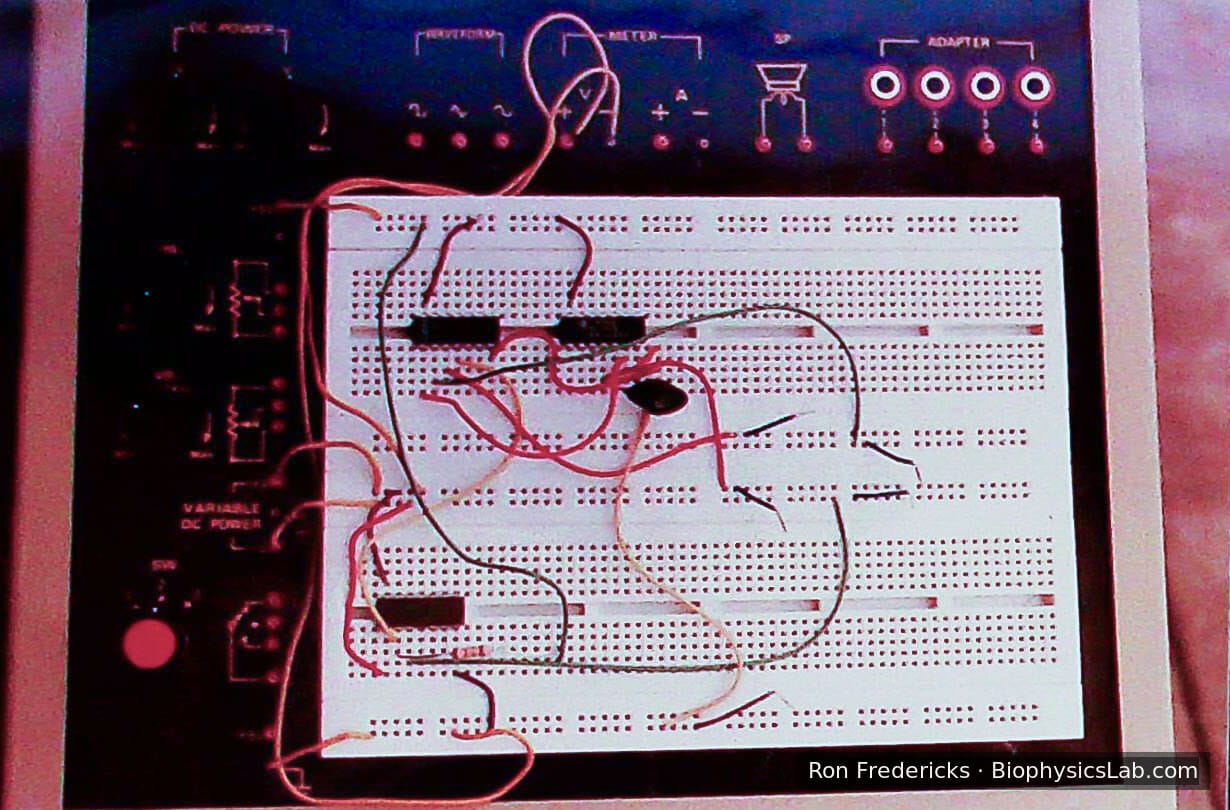
DataCap captured results automatically from the labs’ infrared and somatic cell instruments, starting in 1985. I designed and built the IBM PC interface cards it read from: a pulse-count card and a BCD parallel card, both protected against large voltage spikes, and an RS-232 serial card. Samples could be identified by bar code. For labs with several PCs, I installed purchased point-to-point networking cards and used their IBM PC driver and network software to send DataCap output to files on designated computers. DataCap ran in three versions.
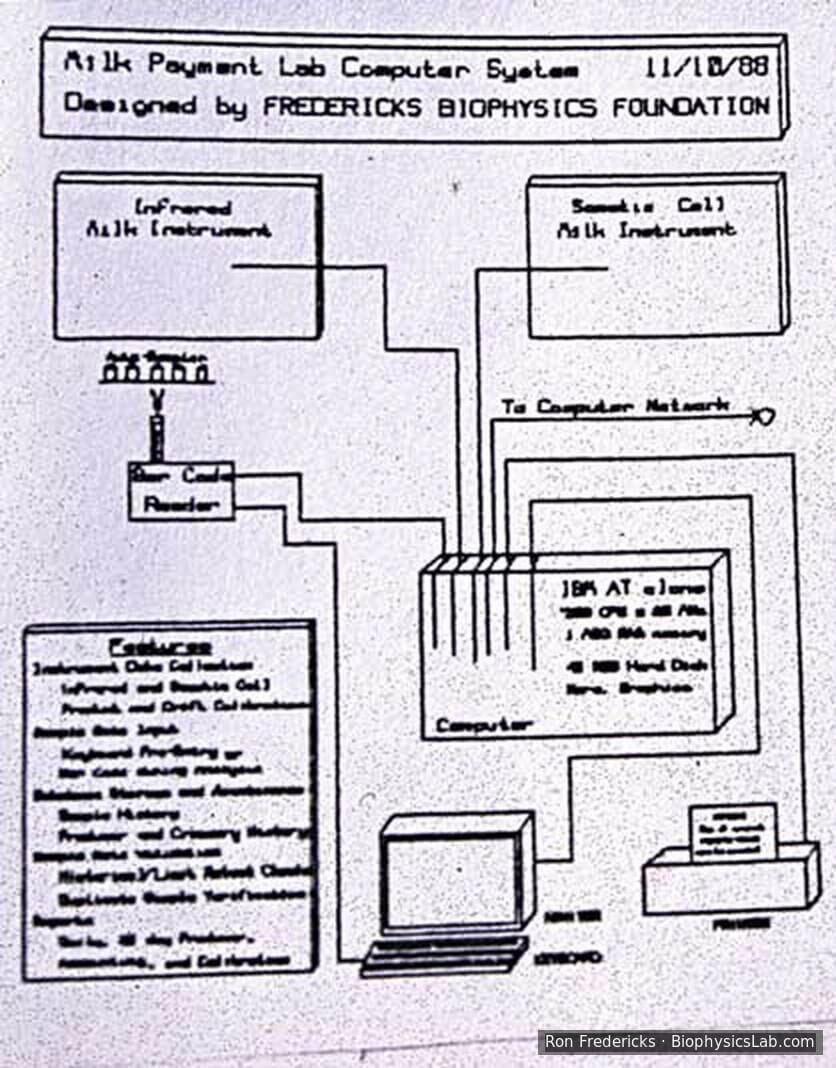
Herd-testing (DHIA) labs. DataCap merged each cow’s infrared and somatic cell results as the samples were tested and printed them directly on the lab’s barnsheet forms, in place of hand-entered results and separate instrument printers. The printed barnsheet served as the paper backup. DataCap also wrote the herd’s records to a text file, which an operator later sent to the DHI computing center by modem with a commercial communications package. I designed the system around the technician’s routine at the instruments: samples in the tray, check samples run and reported, samples flagged for retest, and the barnsheet at the end.
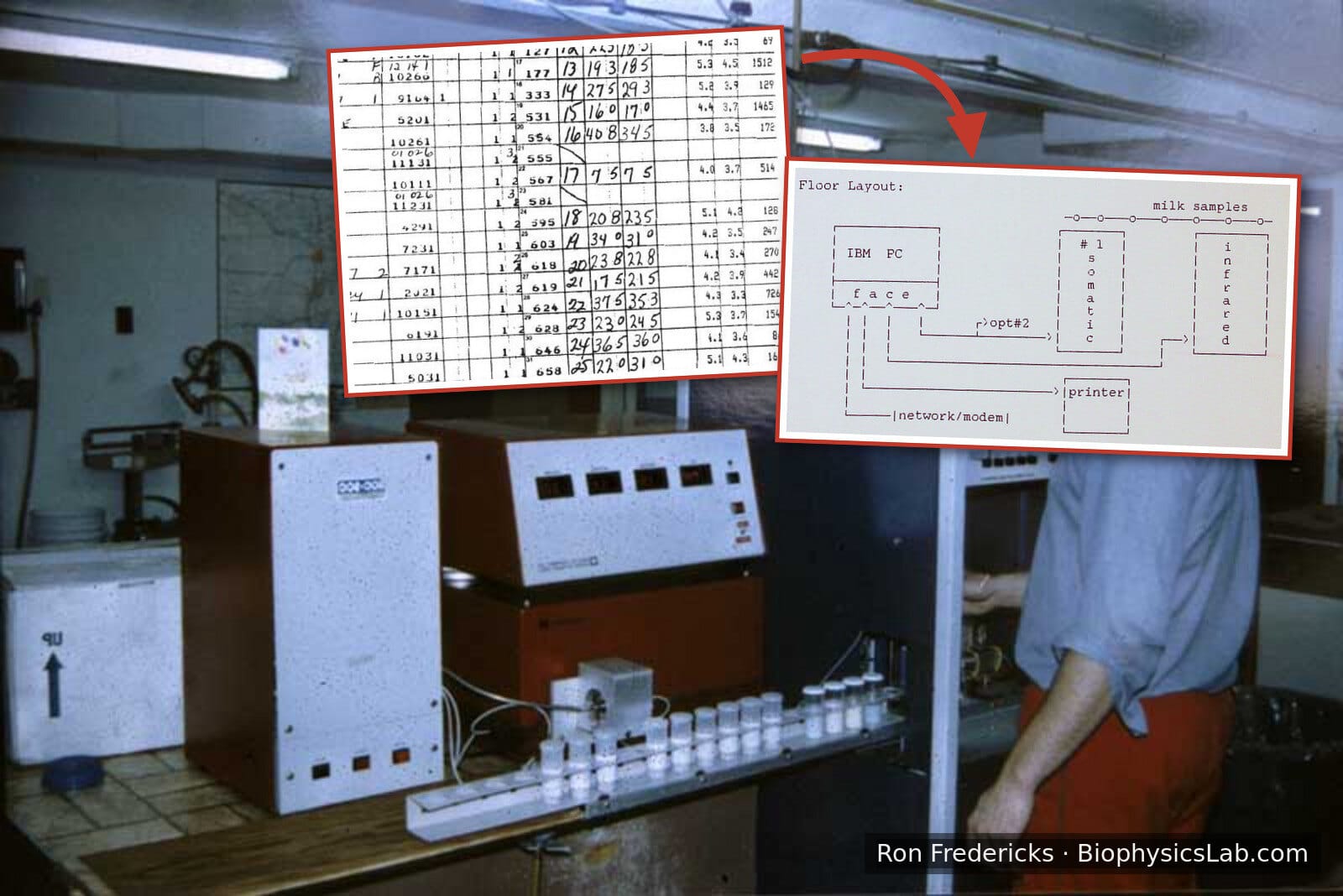
Third-party testing and payment labs. DataCap kept a database of prior test results for each farm’s tank or silo and compared each new result with that history, flagging milk-fat testing errors, added water and other out-of-range results.
Creameries. An option sampled product automatically from the process plant and reported each product’s fat against its production target, for example 2% for low-fat milk and 3.5% for whole milk. Fat over target went into a statement of the financial loss from fat given away; fat under target raised a warning that an inspector could flag the product. Custom product menus handled products such as ice cream blends, where the fat, protein, lactose and solids results need adjustment for added sugar and other ingredients.
At the Sunnyside Farms milk plant, APV Crepaco built the computer-integrated manufacturing system, and I was responsible for the infrared sensors and computers that fed quality-control results back into production, standardizing low-fat milk to 2% fat and homogenized milk to 3.5% fat. To pass the Foss instrument’s fat, protein and lactose results from DataCap to the plant system, I built a custom analog output board that sent each result one digit at a time, with each digit coded as one of ten voltage levels (2 volts for the digit 3, for example). No other lab adopted the board, but it worked. When the plant was rebuilt, I installed the same systems again, and two years later Sunnyside Farms asked me back to improve the feedback from its quality-control lab. Plant managers from other countries visited the installation.
CheckMate and TestMate
The California Department of Food and Agriculture supplied master milk samples that third-party payment labs were required to buy for weekly tests; the raw samples were expensive and did not last. CheckMate supplied secondary standards: sets of four color-coded samples, homogenized, stable and preserved, for hourly checks as needed between the weekly master samples, across a wide range of fat, protein and lactose. I made CheckMate from 1987 in partnership with John Cunningham of Cunningham’s Dairy Herd Testing in Petaluma, a DataCap customer for its DHIA lab work. John mixed and mailed the milk, and I created the calibration recipes from cream, whole milk and skim milk and handled billing and technical support. Subscriber labs also received blind unknowns and an interlab comparison of results. TestMate was a bronopol liquid preservative kit, sold from 1988 until I sold the TestMate line in 1990; one liter of concentrate preserved about 15,000 samples.
Eva-Scan FT-IR milk analyzer
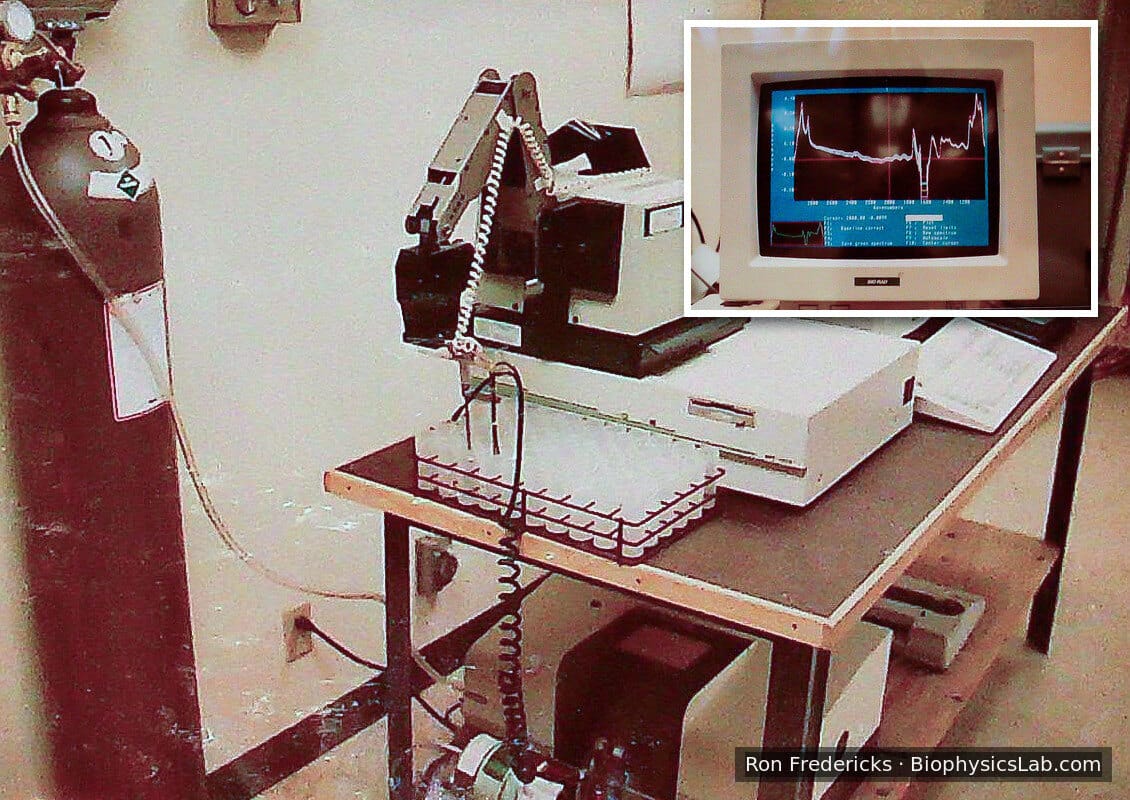
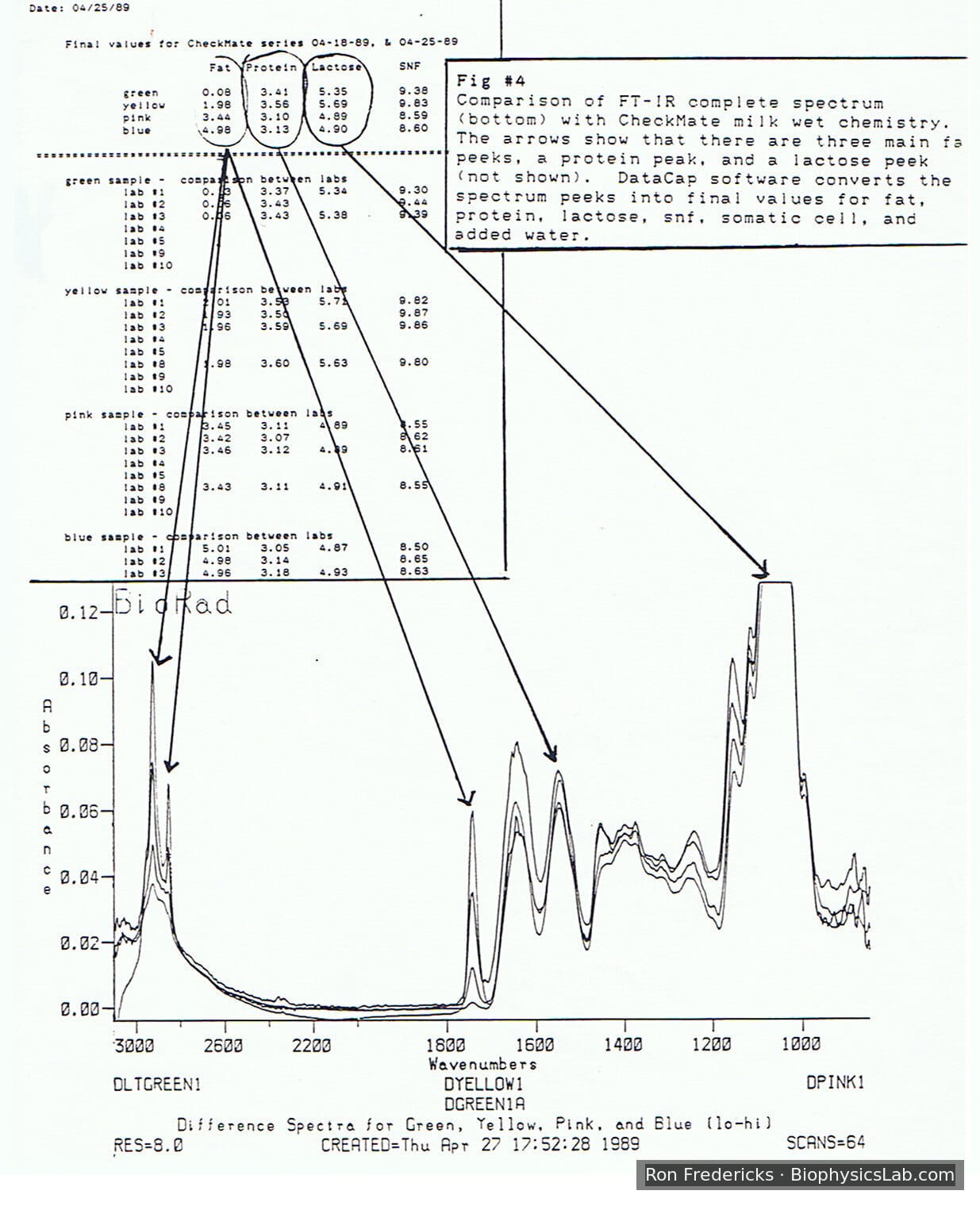
Eva-Scan was a full-spectrum FT-IR milk analyzer: a Bio-Rad FT-IR bench with flow cells I built, a robotic arm that sampled directly from the lab’s trays, a nitrogen purge, a UNIX computer, and DataCap software for calibration, hourly check-sample adjustment, barnsheet printing and PC networking. It measured fat, protein, lactose, solids-not-fat and somatic cells, and displayed each result as a weight percent, a count, or a complete milk spectrum. I demonstrated FT-IR milk analysis to Bio-Rad in October 1988, and trial units ran at Merced DHIA and Fresno DHIA in 1989 and 1990. On February 1, 1990 I presented the work in the New Technology session of the National DHIA Lab Workshop in Las Vegas.
IRCAL
IRCAL calibrated infrared milk analyzers by regression of instrument readings against wet-chemistry results for up to 100 samples, correcting scaling, linearity, homogenization, intercorrection and purge errors, and plotted the error for each component.
DairyLIM
DairyLIM, from 1989, managed quality-control lab data: data-entry forms matched to each lab’s paper forms, audit and period reports, quality-control charts such as Pareto and X̄–R charts, and networking between lab computers.
Microscope studies of homogenization
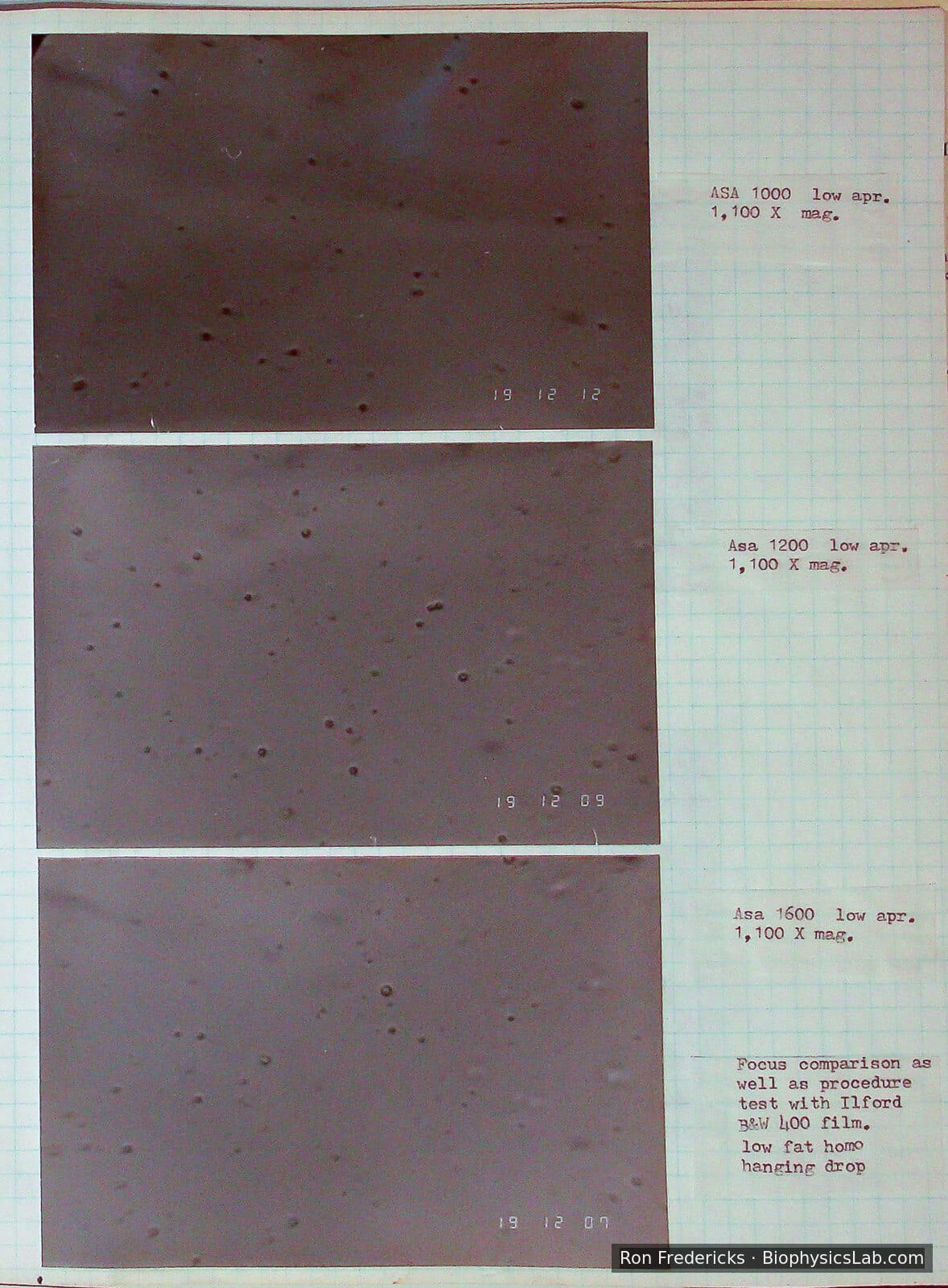
I also photographed milk under the microscope to study homogenization. A page from my 1989 lab notebook shows homogenized low-fat milk in a hanging drop at 1,100×, printed on three film speeds as a focus and procedure test; the dark points are fat globules.
Two patents
Randy Young of Dairy & Food Labs and I are the inventors on two patents from our 1983 applications, both assigned to Dairy & Food Labs.
US Patent 4,510,072, “Composition having neutralized differential infrared absorbency,” filed January 28, 1983 and issued April 9, 1985, covers a milk-sample preservative matched to the infrared analyzer. The analyzers measured fat, protein and lactose on double-wavelength channels, and a preservative that absorbs on any of those channels shifts the result. The patented composition adds a compensating component in a set amount, so that on each channel the preservative’s absorbance at the two wavelengths is equal and cancels in the reading. The patent describes the preservative pressed into a tablet sized for one milk sample, with anti-caking agents, lubricants and a dispersing agent.
European Patent EP 0134798, “A preservative composition for addition to a milk sample for compositional testing, and a method of screening milk samples employing it,” was filed December 29, 1983 from a US application of January 28, 1983, and granted June 8, 1988. It adds a pH color indicator, such as bromcresol purple, to the preservative. As bacteria sour a milk sample, its pH falls from 6.6 toward 4.6 and the indicator changes color, so the lab can set degraded samples aside before testing.
Who the work served
My customers were the labs and plants that test milk: herd-testing (DHIA) labs, which test each cow’s milk for the farmer’s breeding and feeding records; creameries and milk processors, which test incoming milk and standardize their products; independent labs that test milk for payment to farmers; and a DHI data-processing center that compiled the herd-testing labs’ results. They were in California, Arizona, Colorado, Washington, Oregon, Georgia and Utah.
In a February 1989 letter I counted six DHIA labs in three states, eight creameries and two payment labs using DataCap systems; the first DataCap installation was the DHIA lab at Cunningham’s Dairy Herd Testing. I repaired and calibrated Foss and Multispec infrared analyzers, and DataCap read results from Foss, Multispec and Bentley instruments. The Eva-Scan was built on a Bio-Rad FT-IR bench.
Timeline
| Year | Event |
|---|---|
| 1975 | Entered UC Berkeley |
| 1976 | Moved to the biophysics department |
| 1977 | Summer intern at Dairy & Food Labs, San Francisco |
| 1978 | Full time at Dairy & Food Labs |
| 1983 | Patent applications filed with Randy Young, in the United States (January) and Europe (December) |
| 1985 | US Patent 4,510,072 issued (April 9), for a milk-sample preservative formulated for zero net infrared absorbance on the analyzer’s measurement channels DataCap first installed, at the DHIA lab of Cunningham’s Dairy Herd Testing |
| 1986 | DataCap offered to DHIA labs (March) DataCap creamery version |
| 1987 | DataCap third-party testing and payment-lab version CheckMate standards with Cunningham’s Dairy Herd Testing |
| 1988 | European Patent EP 0134798 granted (June 8), for a milk-sample preservative with a pH color indicator TestMate preservative kit FT-IR milk analysis demonstrated to Bio-Rad (October) |
| 1989 | Eva-Scan FT-IR milk analyzer offered Eva-Scan trial units at Merced DHIA and Fresno DHIA, 1989–1990 DairyLIM Homogenization micrographs |
| 1990 | Talk at the National DHIA Lab Workshop, Las Vegas (February 1) Fredericks Biophysics booth at the National DHIA Trade Show, Greensboro, North Carolina (March 11–12) TestMate line sold |
| 1993 | DHIA version of DataCap sold, with exclusive rights, to DHI Computing Service, Inc., Provo, Utah I join Keane, Inc. |
| 1994–1995 | Three Keane software engineers convert the DataCap FORTRAN and assembler code to C++ and support its transfer to DHI |
| 1995–1997 | Technical editor, DECUS magazine |
| 2008 | Last DataCap support to a dairy lab |
After the sale
In 1993 Fredericks Biophysics sold the DHIA version of DataCap, with its FORTRAN and assembler source code, make files and related equipment, with exclusive rights to DHI Computing Service, Inc. of Provo, Utah. The company and its other lines, including the creamery and payment-lab versions of DataCap, calibration and field service, remained mine.
That year I joined Keane, Inc. as a full-time consultant, building safety-critical embedded systems and an interactive uranium knowledge database for GE Nuclear in San Jose. When GE Nuclear moved its work to North Carolina and Keane looked for new work for its San Jose consultants, I proposed and delivered a project in which three Keane software engineers converted my DataCap FORTRAN and assembler code to C++ and supported its transfer to DHI in 1994 and 1995. Keane gave me a Certificate of Recognition for generating the DHI Computing Service lead and contributing to the closure of the business.
Beginning while I was at Keane, from 1995 to 1997 I was a technical editor for DECUS magazine, published for the Digital Equipment Computer Users Society, whose members shared software for DEC computers such as the PDP-11 through one of the largest user software exchanges of its time.
I went on to write embedded real-time software, and kept supporting dairy labs’ DataCap systems under my own name and later through Embedded Components, Inc. until 2008, with Multispec repairs, DataCap installations, Y2K date fixes and an interface for a Bentley Combi instrument.
From milk analysis to milk fat globule membranes
In the dairy labs I designed the sample, the instrument and the calibration together: a preservative balanced against the analyzer’s measurement channels, check standards made to span the calibration range, and software built around the technician at the instrument. My 2027 research program applies the same approach to the milk fat globule membrane.
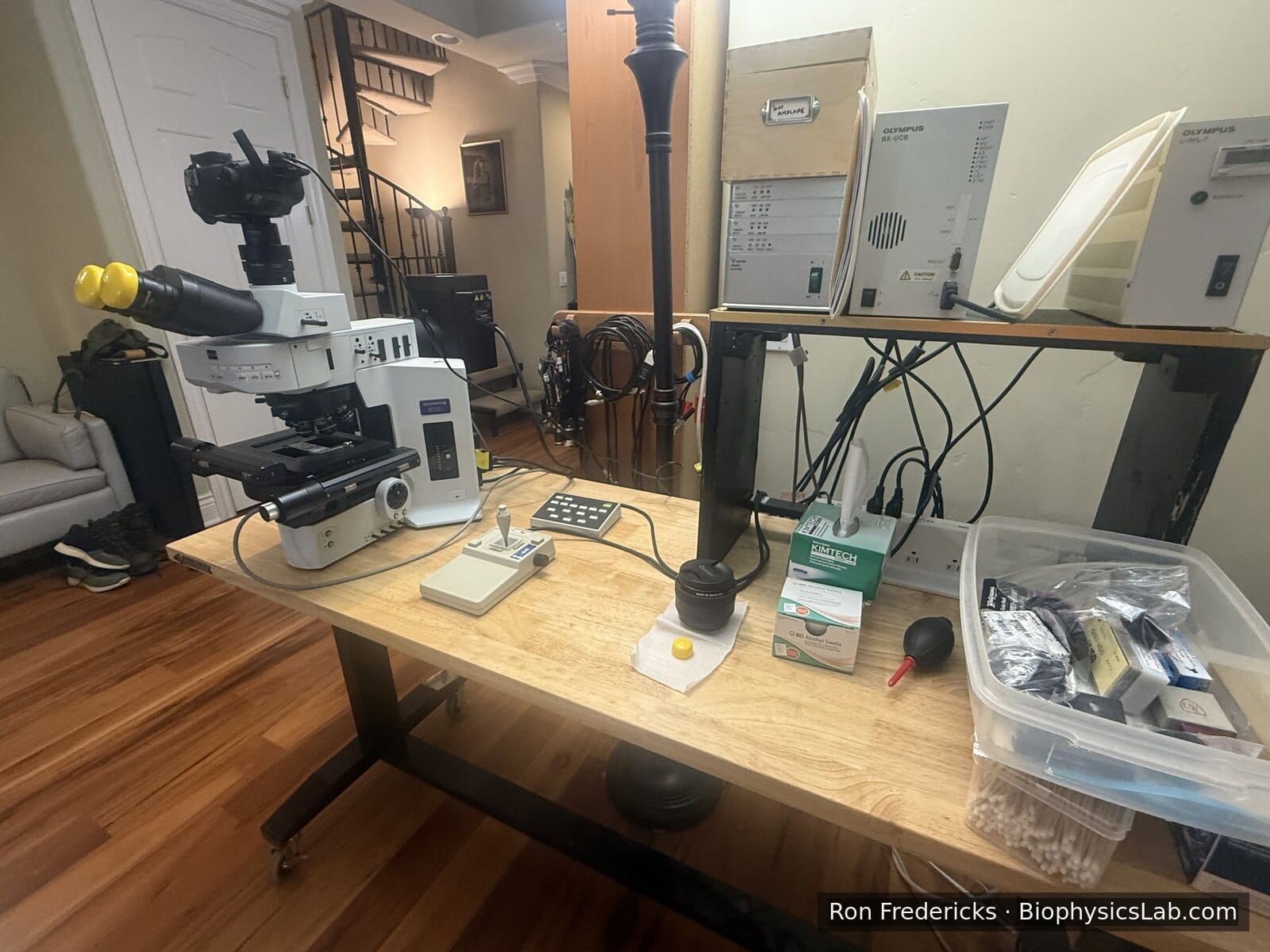
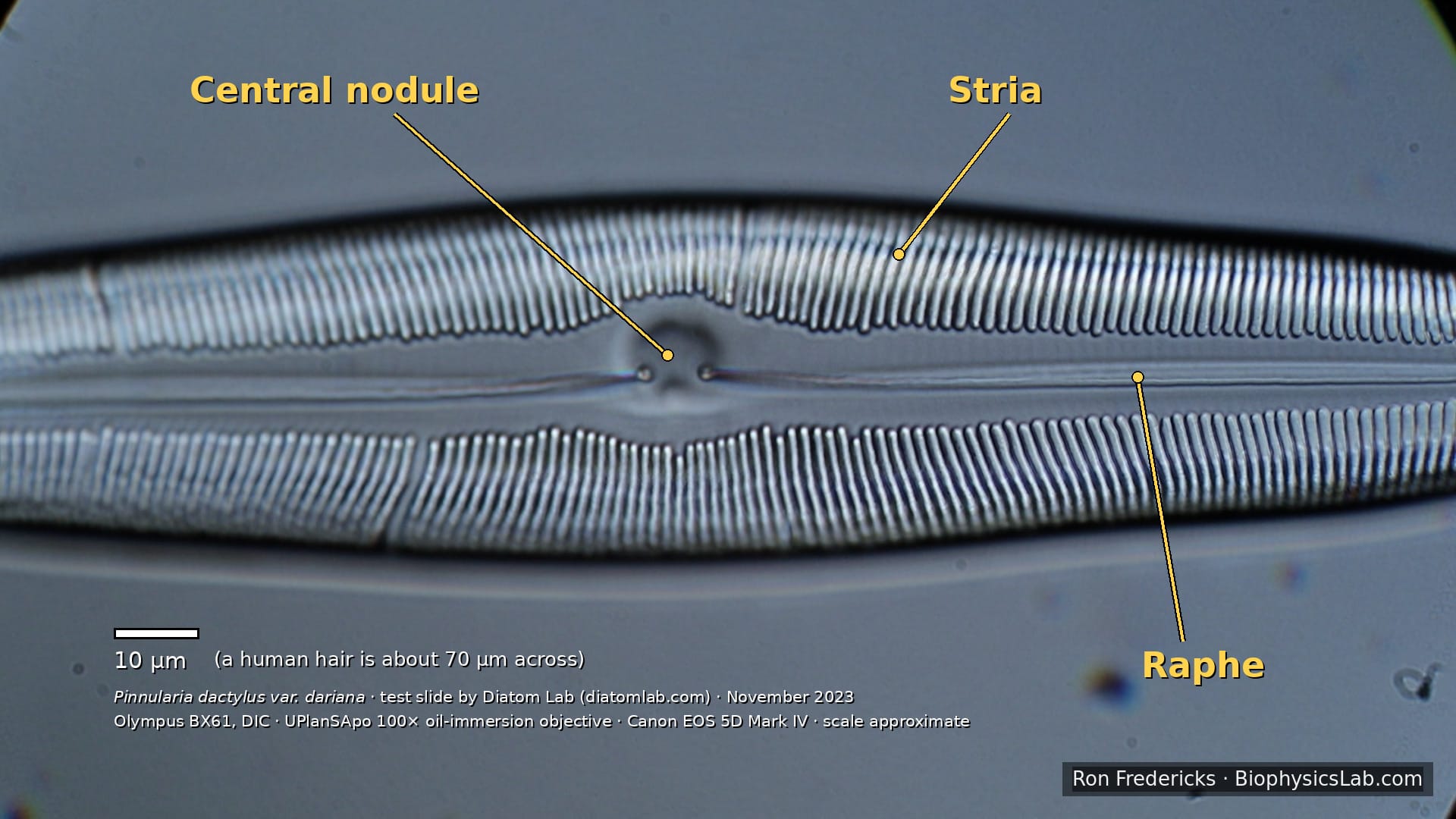
In 1989 I photographed homogenized milk at 1,100× on film. In 2018 I bought a used Olympus BX61 microscope for DIC and fluorescence work, shipped in parts, and began assembling and aligning it in my lab. An Olympus-certified service company from Sunnyvale visited twice, first to test my alignment and train me on the system, then to clean the optics and train me again, and completed verification of the alignment in 2023. I checked the oil-immersion objective with a diatom test slide from Diatom Lab (diatomlab.com). The program starts with DIC microscopy of milk fat globules on the BX61 and moves on to electrical measurement of the globule membrane.
The records behind this page are in my archive; posts on individual products will follow.
Photos and scans on this page are from my archive and are shared under the Creative Commons Attribution 4.0 International license (CC BY 4.0). You may copy, adapt and reuse them, including commercially, with credit to Ron Fredericks, BiophysicsLab.com.